
“The Samurai and the Prisoner” Review
In feudal Japan, Lord Murashige must solve the mystery of a murdered prisoner in order to keep his alliances together in the genre-defying “The Samurai and the Prisoner.”
“The Samurai and the Prisoner” has one of the more captivating hooks in recent memory: a mystery set in feudal Japan, with a peace-seeking Lord desperately trying to solve a murder in order to keep his followers loyal in the face of a siege from a bloodthirsty conqueror. Yet this thrilling concept undersells the thematic ambition of Kiyoshi Kurosawa’s latest film, filled as it is with moral and philosophical explorations of death and virtue in a time of constant killing. Even as the story strains underneath its thematic and genre aims, Kurosawa has delivered a singular film with stunning cinematography and police procedural thrills that will satisfy a wide range of viewers.
The film opens with the brutal warlord Oda Nobunaga on a bloody trail of conquest throughout Japan, only to be betrayed by one of his most loyal followers, the comparatively gentle, thoughtful Araki Murashige (Masahiro Motoki), who gathers all of his own supporters and establishes defensive fortifications in Arioka Castle. Oda sends a clever envoy, Kuroda Kanbei (Masaki Suda), who fails to convince Lord Murashige to surrender and is wrongfully imprisoned despite his pleas to be executed, as is the proper way to deal with a samurai honorably.
When another prisoner is murdered within the castle walls, Lord Murashige finds himself going to the one person he knows to be innocent, the chained-up Kanbei, to help him solve the crime and keep his fragile coalition of allies intact, proving to them that he is a leader worth following.
The film is broken into four chapters, one for each season of the year 1579 as Arioka Castle is under siege. Each season presents a new mystery, a new challenge to Lord Murashige’s delicate equilibrium, that requires collaboration with his prisoner. In the tradition of whodunits, the main character is flipped into being a feudal samurai version of Dr. Watson, constantly going down into the dungeons to consult with his imprisoned Sherlock Holmes.
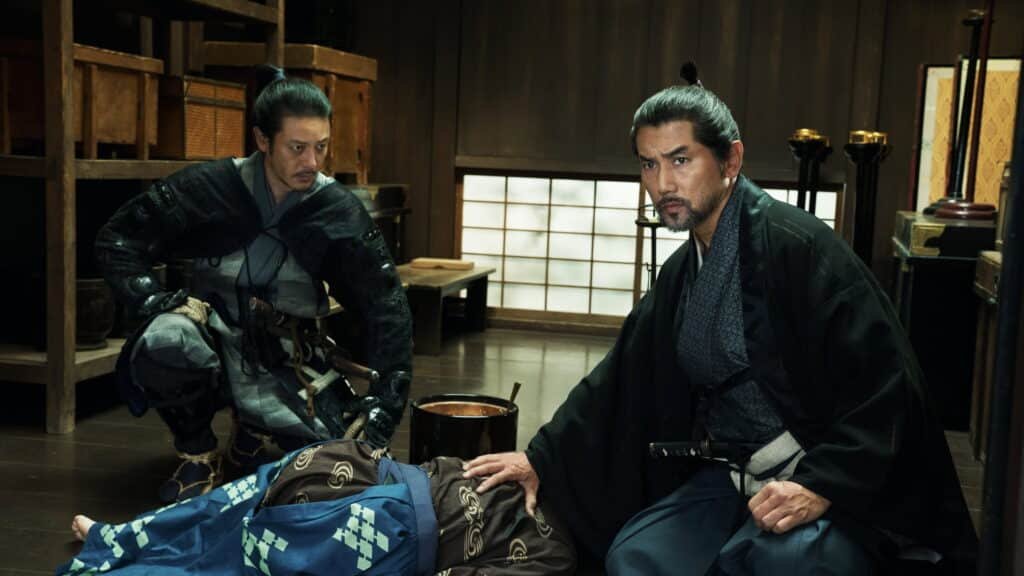
While the individual mysteries are fun they are sometimes not as well developed as would be desired for maximum payoff, with Kurosawa instead playing one scene in which Kanbei vaguely hints at a solution, only to immediately cut to Murashige confronting the suspect, with precious little in the way of finding clues and letting a solution come organically to the viewer and characters alike. This choice may result in slightly less satisfying mysteries, but it is an intentional decision to shrink the mystery in favor of the grander thematic ideals, as Kurosawa focuses deeply on questions of faith and morality in times of war.
Throughout each season, characters deal with their own decisions, to kill or spare life, as well as the more ambitious questions of Buddhism, or Christianity, and how valuable either belief system is in the face of Oda’s relentless cruelty. “Advance to Paradise, Retreat to Hell” is a proclamation repeated throughout the film, sometimes as a call to action, and sometimes as a question as to who decides life and death in times of conflict.
Rarely has a mystery looked as good as “The Samurai and the Prisoner”, with such textured photography, each frame rich in detail, from the characters’ movements and the world they inhabit to the way the light, from the sun or candle, plays across the screen. Without the need for words, the idyllic beauty of the imagery highlights the tragedy of war in its capacity to destroy the innocent.
While “The Samurai and the Prisoner” achieves its best moments in the first act, the entire film is an ambitious and rewarding experience that will haunt audiences not just with its mysteries, but with its perceptive questions of right and wrong in the face of death.
The Samurai and the Prisoner
Rated NR
Running Time: 2 hours and 27 minutes.
Director Kiyoshi Kurosawa
Writers Kiyoshi Kurosawa
Stars Masahiro Motoki, Masaki Suda, Yuriko Yoshitaka, Munetaka Aoki
Rating NR
Running Time 147 Minutes
Genres Drama, History, Mystery, Thriller, War