
‘Hamnet’ Review
After the death of their son, Hamnet, Agnes and William Shakespeare process their grief in dramatically different ways in Chloé Zhao’s emotional powerhouse, ‘Hamnet’.
After an unfortunate detour into the Marvel Universe with 2021’s disappointing ‘Eternals’, Chloé Zhao returns to her forte of dramatic, humanist storytelling in ‘Hamnet’. With a painterly sense of framing and lighting and a sympathetic attention to character, Zhao brings to life a rich, textured world and allows room for the stunning acting and impassioned themes to devastate even the most cold hearted audience.
We open with a courtship, between Latin tutor William (Paul Mescal) and a rumored forest witch in Agnes (Jessie Buckley). They are drawn to each other just as they are spurned by their community that doesn’t know how to accept people who don’t fit neatly into the agrarian, hardworking, practical society of 16th Century rural England. William dreams of the stage, struggling as he does with communicating in person, relying on his writing to convey his feelings. Agnes, with her mystical heritage, often sees visions of the future with a single touch and is thus confident that she and William will have two children by her side on her deathbed. This prophecy is put into question however when Agnes, having already had one daughter, births an unexpected pair of twins. After her daughter Judith comes out of the womb stillborn only to be revived moments later, Agnes and William fixate on Judith, worried that tragedy will come to her, determined to protect her from the world. But years later, when the plague reaches their small village, it is Judith’s twin brother, Hamnet, who is inflicted, bringing tragedy to the entire family.
The William in question, of course, is William Shakespeare, yet much of the film’s power comes from centering the narrative on Agnes. Jessie Buckley’s performance as Agnes is magnetic and layered, tender during the romantic courtship and heartbreaking as she willfully inflicts pain upon her partner, unable to comprehend William’s specific manner of grieving.
‘Hamnet’ is thematically dense without sacrificing any of the beauty of its characters or narrative, dealing as it does with questions of masculinity and grief. William and Agnes are misunderstood by polite society, and yet they always understand one another, up until Hamnet’s passing. With the death of her only son, Agnes lashes out at Will, uttering the most cruel words, accusing Will of moving on when, in fact, Will just processes his own grief through his art. The grief of losing a child is so personal, such that even such intimate partners as Agnes and Will experience it so differently, and yet through Will’s art he channels his hyper-personal anguish into something universal, bringing an audience of strangers into his pain over his lost son.
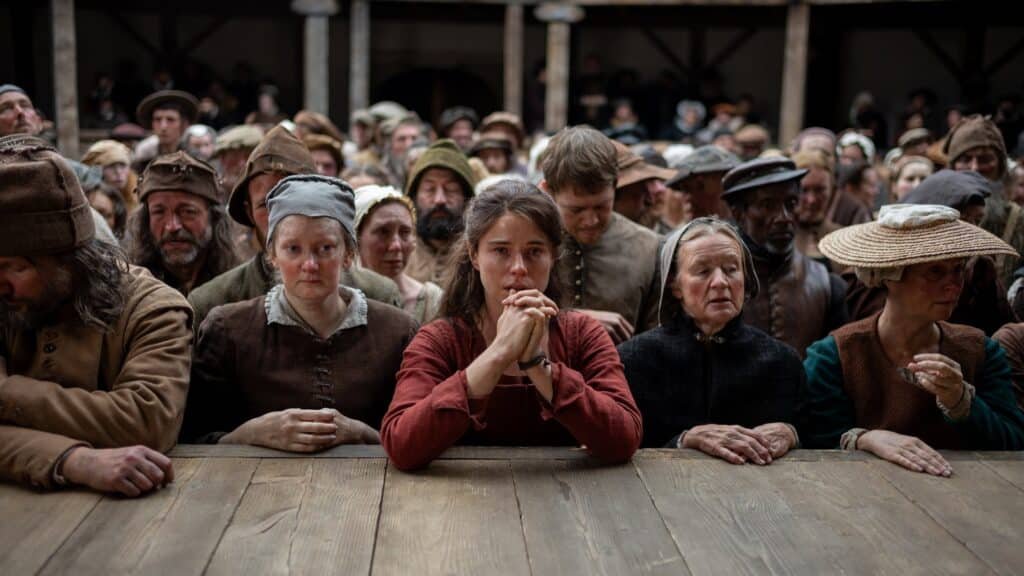
Zhao wisely lets her shots linger, allowing the performers to explore their characters onscreen, uninterrupted, resulting in some of the best acting of the year. Paul Mescal has become one of Hollywood’s go-to sad boys, yet here he delivers so much nuance as an artist in a rough world that scorns men who don’t use their hands for their livelihood. As Shakespeare, Mescal exhibits an internal rage, bristling at the limitations placed on him by his surroundings and frustrated with his own father’s moral superiority despite his shortcomings. Even as he spends more and more time in London, away from his family, Will dotes on his own son, Hamnet, to prove to himself that he will be a better father than his ever was.
As William’s mother, Emily Watson gives a wonderfully subdued performance that is a perfect match for Zhao’s direction. In her early scenes, Watson is violently against a marriage between Will and Agnes. There are no emotional make up scenes, no obvious bonding moments, yet we slowly start to see Watson with Agnes more and more, bringing warmth and discipline to the family, eventually accepting them as they are. Zhao trusts the viewer to intuit this character and her relationship to Agnes as two mothers who have experienced an unfathomable pain, and Watson smartly plays the layers of her character’s suffering: once as a grandmother at risk of losing her grandson, and twice as she relives her own child loss.
And finally, special attention should be given to all of the child actors in the cast, who exhibit distinct personality and a notable comfort with the restrained dialogue of their characters. Child performances can often be too cutesy, too precocious in a way that no child ever is. And yet Jacobi Jupe, Olivia Lynes and Bodhi Rae Breathnach as Hamnet, Judith and Susannah respectively give shockingly emotional, mature performances without coming off as anything other than children, adding an extra element of sorrow to their family trauma.
Chloé Zhao’s direction is patient and delicate, taking her time in the beginning to set up Agnes and Will’s romance, their dreams and their fears, knowing that the more time spent on these characters early on will pay off in the most heartrending tragedy possible. Zhao, with Łukasz Żal’s brilliant cinematography and Max Richter’s gorgeous score, absorbs the viewer into the lush, natural beauty of a world untouched by modernity.
‘Hamnet’ is a bold, emotional powerhouse of a film that dares humanize William Shakespeare, nemesis of high schoolers everywhere, as not only an artistic genius, but as a father and husband who has experienced a lifetime of pain. Chloé Zhao and the writer Maggie O’Farrell bring renewed life to ‘Hamlet’, as well, making all of its emotions so much more immediate and poignant, declaring that art connects us all even as we’re removed from its inspiration.
Hamnet
Rated PG-13 for thematic content, some strong sexuality, and partial nudity.
Running Time: 2 hours and 6 minutes
Director Chloé Zhao
Writers Chloé Zhao, Maggie O’Farrell
Stars Jessie Buckley, Paul Mescal, Emily Watson, Joe Alwyn
Rating PG-13
Running Time 126 Minutes
Genres Tragedy, Biography, Drama, History