
“The Odyssey” Review
In Christopher Nolan’s adaptation of Homer’s epic, Odysseus must overcome all manner of fantastical challenges to return to his kingdom and his family.
“The Odyssey” is a perfect pairing of Hollywood’s preeminent epic filmmaker with one of history’s greatest epics, resulting in a reluctant adventure story with modern sensibilities attached to throwback cinematic style, an undeniable spectacle with astounding scope and ambition even as it rushes too quickly from one episode to the next.
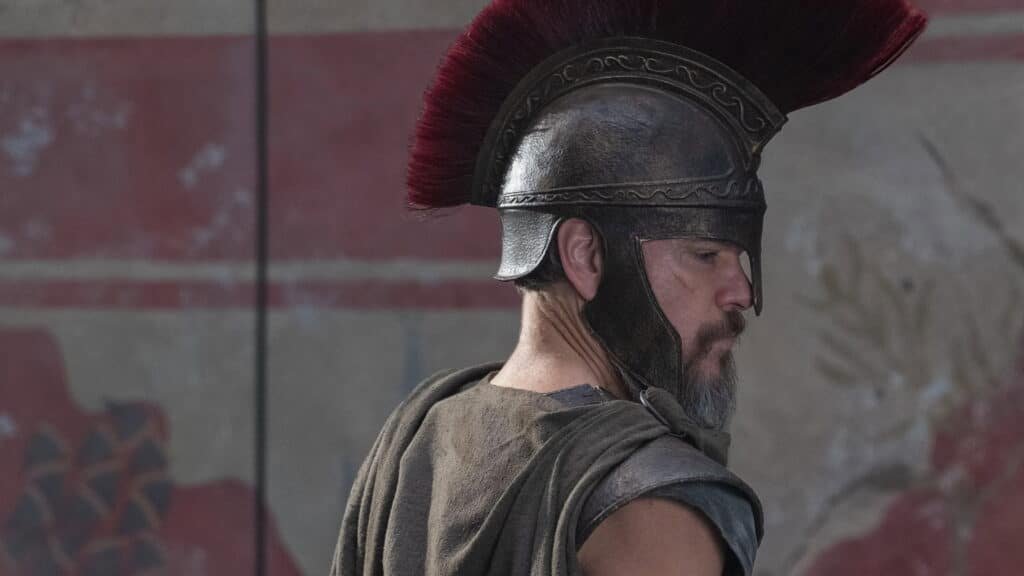
After the fall of Troy and the end of the Trojan War, Odysseus (Matt Damon) sets sail homeward to his kingdom of Ithaca, his wife Penelope (Anne Hathaway) and his son Telemachus (Tom Holland). Gone ten years already, Odysseus and his men don’t know what kind of Ithaca they will be returning to and must overcome all sorts of fantastical challenges on their long journey home.
Meanwhile in Ithaca, Penelope is beset by dozen of suiters, claiming that Odysseus must be dead or he would have returned home already and that she must marry anew to have a king on the throne to address the new challenges of a broken world.
“The Odyssey” is a master class in production design and world building. Troy, Ithaca, every stop along the way is brought to life with such care and attention to detail, each setting is tactile and weathered. For a film packed with mythological conflict, Christopher Nolan keeps the action grounded through his dedication to crafting every frame with meticulous care, delivering every set piece with a defiantly human touch.
The film, with its three hour runtime, never lags. On the contrary, oddly enough, the story feels rushed. Trying to fit in as many episodes as possible from the original epic, Nolan rushes from conflict to conflict, having Odysseus and his fellow soldiers arrive at an island, encounter conflict, flee from island in quick order. There is no space to patiently establish atmosphere, dread or awe and there is precious little of Odysseus applying his wits to solving the problems facing he and his men, beyond one scene where he just rattles off how he will handle the Sirens, Scylla and Charybdis in quick succession, giving Nolan license to just breeze right through what should be bombastic encounters.
Like all of his films, Nolan is able to craft memorable sequences without necessarily deploying clever blocking or staging, relying instead on big images to convey big feelings, and even bigger sound that risks drowning out the dialogue and numbing the audience. The strongest parts of the film are the entirety of the Trojan War as well as Circe’s trick on Odysseus’s men, turning them to pigs in a memorably horrifying sequence while the weakest segments are the ones that come and go too quickly, such as the battle with the Laestrygonians or the long convalescence on Calypso’s island.
Just as the source material is a natural fit for Nolan’s style of filmmaking, Odysseus is a natural Nolan protagonist – a grim-faced, determined hero who faces all challenges head-on, so focused on the work that he doesn’t have time for feelings. Matt Damon’s Odysseus is a brooding and stoic archetype equally at home in “Oppenheimer,” “Interstellar,” or the entire “Batman” trilogy.
While the cast is filled with great performances, some of the most noteworthy help advance Nolan’s modern deconstruction of Odysseus as an unambiguous hero. Himesh Patel as Eurylochus serves as a foil to Odysseus, loyal and committed even as he grows fatigued with Odysseus’s inscrutable decision making. Lupita Nyong’o, as both Helen of Troy and Clytemnestra, is filled with righteous but restrained fury, putting the lie to the idea of the Trojan War as a noble, heroic quest. Jon Bernthal, Samantha Morton and Robert Pattinson deliver memorable characters in little time and Charlize Theron is a fantastic Calypso, imbuing her character with so much complicated emotion in such little time, but her performance just leaves me wishing that segment was given more room to breathe, rather than serving entirely as a story framing device.
Christopher Nolan pushes the source material into a decidedly modern direction, depicting Odysseus not as a simple, laudable hero but as a morally complex man in an amoral time, grappling with his own suffering as a direct consequence of violating Zeus’s Law. Odysseus, Agamemnon, Menelaus are all men haunted by what they’ve done, living in fear for the day divine justice punishes them for the underhanded trick they played on the Trojans. In war, there are no heroes, only survivors.
This messaging about how the trick Odysseus played to win the war broke him and the world is undermined by Nolan’s unwillingness to really dwell on the rape and pillage of Troy, choosing instead to cut away from anything that would be too upsetting, too visceral. What does ten years of rage being unleashed on men, women and children look like? I don’t know, because Nolan didn’t want to show it.
This message though would be better received if further changes were introduced, instead of wrapping up the saga with a happy ending, literally sailing off into the sunset.
They don’t make movies like this anymore. In its epic sweep and cinematic ardor, “The Odyssey” is the kind of big budget Hollywood extravaganza that is increasingly rare. Even with its under developed episodes, rushing from one moment to the next, this is an undeniable achievement, commendable for its ambition and vision.
The Odyssey
Rated R for violence and some language.
Running Time: 2 hours and 53 minutes
Director Christopher Nolan
Writers Christopher Nolan
Stars Matt Damon, Tom Holland, Anne Hathaway, Robert Pattinson, Lupita Nyong’o, Samantha Morton, Zendaya, Charlize Theron
Rating R
Running Time 173 Minutes
Genres Adventure, Drama, Fantasy