
‘28 Years Later: The Bone Temple’ Review
‘The Bone Temple’ focuses on world building and the conflicts among and between humans as our hero Spike is forced into a murderous cult terrorizing the country.
‘The Bone Temple’, the second installment in a proposed trilogy following last year’s ‘28 Years Later’, lacks the narrative clarity of its predecessor, which told a tight, self-contained story of one boy’s journey through a zombie infested hellscape in an effort to save his mother’s life. Here, that film’s proactive main character is relegated to the role of horrified passenger, coerced into joining a murderous cult as he pays passive witness to mutilation and horrors beyond his innocent imagination, powerless to change his circumstances. By centering the story on a protagonist devoid of agency, ‘The Bone Temple’ is far stranger than ‘28 Years Later’, playing out like a blood-soaked fever dream with more in common with a ‘Mad Max’ dystopia than typical zombie fare.
‘The Bone Temple’ picks up where its predecessor left off, with Spike (Alfie Williams) being held by a cult like gang of roving murderers calling themselves the Jimmys, led by one who goes by the name Lord Sir Jimmy Crystal (Jack O’Connell). Elsewhere, Dr. Ian Kelson (Ralph Fiennes), continues his quiet but horrific life in his Bone Temple, a memento mori that serves as a fitting home base for his research into the zombie outbreak and whether a cure is possible.
If the first ‘28 Years Later’ was about family, and the societies we build after the end of the world, ‘The Bone Temple’ is much more interested in belief systems and how they warp and atrophy in the face of civilizational collapse. Jimmy is an avowed Satanist, a cult leader styled on notorious UK pedophile Jimmy Savile, who leads his not-so-merry band of homicidal misfits, attired in blond wigs, tracksuits, and upside down crosses recalling Charles Manson’s equally aimless and sadistic followers.
Dr. Ian, on the other hand, is an atheist who, despite his own traumas, looks at the rage-driven apocalypse not in spiritual terms, but practical ones. The zombie outbreak is not a divine message to be interpreted, but a scientific problem to be solved.
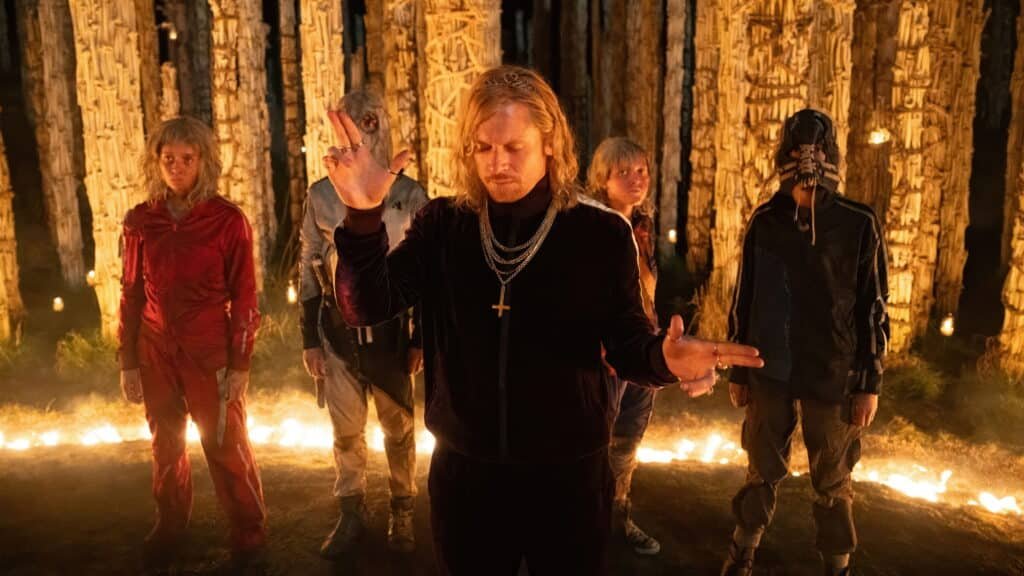
While the entire cast delivers strong performances, ‘The Bone Temple’ is two parallel storylines driven by two competing lead characters who are critical to this movie working: Ralph Fiennes as Dr. Ian and Jack O’Connell as the leader of the Jimmys. Both of these actors deliver incredible characters, and the movie is at its best when these two meet, with their wildly different personalities, clashing like two wild animals trying to understand the other.
For an actor with a career filled with so many iconic villain performances, Ralph Fiennes has proven again and again equally capable of generating warmth and comfort when the role demands it. Here, Fiennes expands on his character introduced in the prior film: a doctor whose evil appearance and suspected psychosis belie a gentle soul, who speaks softly and listens attentively to the pain and suffering of humans and zombie alike. When he speaks, it’s easy to forget the dangers all around and find peace, confident that everything will turn out all right.
O’Connell’s performance lacks the grace and kindness of Fiennes, with those virtues replaced by egotism and cruelty. Jimmy is a grown man frozen in time, emotionally and mentally, as the small child he was when the world ended, and O’Connell turns in a nuanced performance that echoes his similar role from last year’s ‘Sinners’: a violent huckster whose slick-tongued charm is laced with menace.
As in many second installments in trilogies, ‘The Bone Temple’ is less a freestanding storyline than it is a deeper exploration of its world and ideas, serving as deliberate connective tissue between the introductory and concluding films, resulting in some odd pacing even as its bizarre tangents are as evocative as any more standard horror.
I’m sure I’m not the only person who was thrown off by the final scene in ‘28 Years Later’, when the Jimmys were first introduced with whacky music, kung fu fighting and tracksuits. It was a silly moment discordant with the rest of the film’s more somber, contemplative action. This silliness is expanded even further in ‘The Bone Temple’, sometimes to the film’s detriment, even as it feels more fitting with this film’s more surreal nightmare. We get pop culture one liners and out-of-place musical cues, most notably an interpretive dance set to Iron Maiden’s ‘The Number of the Beast’, that will make some people giddy with joy while others roll their eyes.
While not quite as good as the first ‘28 Years Later’, ‘The Bone Temple’ sticks the landing with a bit of fan service played wonderfully, with a killer musical selection, that left me with a dumb smile on my face and unreasonable excitement for the eventual conclusion to come.
28 Years Later: The Bone Temple
Rated R for strong bloody violence, gore, graphic nudity, language throughout, and brief drug use.
Running Time: 1 hour and 49 minutes
Director Nia DaCosta
Writers Alex Garland
Stars Ralph Fiennes, Jack O’Connell, Alfie Williams, Erin Kellyman, Chi Lewis-Parry
Rating R
Running Time 109 Minutes
Genres Horror